Powder
1–2 g — half to one level teaspoon — once or twice daily. Daily total 1–4 g.

 Zoom
Medicinal & Therapeutic Herbs
Tabebuia avellanedae (syn. Handroanthus impetiginosus)
Also known as: Pau d'arco, Lapacho, Taheebo, Aztec tea, ipe roxo, iperoxo.
Pau d'arco is the inner bark of a tropical tree of Central and South America, known in Brazil as pau d'arco and taheebo. Indigenous peoples of the Amazon have used it as a beverage for centuries. It is of interest to those seeking support with fungal overgrowth, inflammation and joint pain.
Last updated: October 2026
We work with the following courier companies to ensure fast and reliable delivery:
Most products are dispatched within 1–2 business days of order confirmation. For bank transfers, the time counts from receipt of payment. If a product is temporarily out of stock, dispatch may take 3–5 business days and we will notify you promptly.
| Destination | Delivery time | Note |
|---|---|---|
| Athens and major cities | 1–2 business days | |
| Regional areas | 1–3 business days | |
| Islands and remote areas | 2–5 business days | Subject to route schedules |
| EU countries (DHL) | usually 4–6 business days | Depending on the destination |
| Cyprus (ACS Courier) | 5–7 business days | From the departure of the ship |
Delivery times count from the day of dispatch. They are estimates and may be affected by circumstances beyond our control (strikes, adverse weather, etc.).
On orders over €49, shipping is free for the first 3 kg. If your parcel is heavier, you keep the free shipping and pay only for the extra weight, at €1.50 per kg.
Free shipping does not apply to orders up to €49. Shipping starts from €3.50 for parcels up to 2 kg. The exact amount is calculated automatically at checkout, based on the courier, the weight and the destination, and is shown before you complete your order.
Tip: combine your purchases into a single order over €49 to get free shipping.
Paying by cash on delivery costs an extra €2.50, on top of the shipping cost.
Once your order has been dispatched, you will receive an SMS or e-mail with a tracking number so you can follow your parcel in real time.
If you are unable to collect your parcel in time, please contact us and we will find a solution. If a parcel is returned to us without prior notice, the outbound and return shipping costs are charged to the customer. See our Returns Policy for details.
We ship to all European Union countries with DHL, from €18 (Cyprus and Malta from €20). For Cyprus you can also choose ACS Courier (from €9.60). The exact cost is shown at checkout, before you pay.
On EU orders over €200, shipping is free for the first 2 kg and you pay only for the extra weight.
Since all shipments travel within the European Union, there are no customs duties or import charges.
Full details on our International Orders — European Union page.
Shipping and Delivery · International Orders — European Union
PAYMENT METHODS
Last updated: May 2026
All products, prices, and shipping terms are confirmed in your order confirmation e-mail. Payment is made before delivery and can be completed using one of the following methods:
1. CREDIT / DEBIT CARD
We accept Visa and Mastercard (credit and debit cards) with full security via Piraeus Bank / Epay. No additional charge.
• Google pay/Apple pay
• SSL encryption — your card details are never stored on our systems
• Instant order confirmation
• No additional fees
2. CASH ON DELIVERY
Pay in cash directly to the courier representative upon delivery. A service fee of €2.50 applies.
Available for deliveries within Greece only.
3. BANK TRANSFER
After placing your order, please wait for our e-mail confirmation of product availability. Then transfer the total amount to one of the following accounts:
Bank | IBAN | Account No. |
National bank | GR3201108360000083600252080 | 836 0025 2080 |
Alpha Bank | GR3901405300530002101442697 | 530002101442697 |
Eurobank | GR2002606720000990200149181 | 0026067299 0200149181 |
Piraeus | GR9401725070005507082823498 | 5507082823498 |
Bank IBAN Account No.
Εθνική Τράπεζα GR3201108360000083600252080 836 0025 2080
Alpha Bank GR3901405300530002101442697 530002101442697
Eurobank GR2002606720000990200149181 0026067299 0200149181
Πειραιώς GR9401725070005507082823498 5507082823498
Account holder: ANASTASOPULOS VASSILIOS
•No additional charge for transfers from the same bank
•Transfers from a different Greek bank may incur standard inter-bank transfer fees (e-banking)
•Transfers from a bank outside Greece: an additional fee of €4.00 applies, to be added by the buyer to the total amount transferred
•We recommend notifying us by e-mail (info@yperikon.gr) once the transfer is made, including the date and bank used — this helps us dispatch your order faster
4. IRIS PAYMENTS
You can pay instantly via IRIS using our Tax ID (AFM):
Tax ID (AFM): 104130231
IRIS Payments enables instant bank-to-bank transfers at no charge.
Note: Bank transfer and IRIS Payments are available for orders within Greece only. For EU orders, please use card payment at checkout.
Send us a message and we reply within one working day. Or call us on (+30) 2610 221354 during shop hours.
Send a message(+30) 2610 221354Pau d'arco is the inner bark of a tropical tree of Central and South America, known in Brazil as pau d'arco and taheebo. Indigenous peoples of the Amazon have used it as a beverage for centuries. It is of interest to those seeking support with fungal overgrowth, inflammation and joint pain. There are nearly a hundred species in the genus, but only a few yield bark of high phytochemical quality, which is why identification by experienced harvesters is decisive. Records of medicinal use of the tea go back to 1873.
The bark is characterised as antifungal, antimicrobial, anti-inflammatory, analgesic and antioxidant, with additional diuretic and tonic action. This character rests on naphthoquinones, chiefly lapachol and beta-lapachone, together with quinoids, benzenoids, flavonoids and selenium.
At a preclinical level the bark has been studied for inhibitory activity against viruses and against methicillin-resistant staphylococcal strains, for gastric ulcer healing in laboratory animals, and for inhibition of pancreatic lipase, the enzyme that digests dietary fat.
The bark is traditionally associated with candida and fungal overgrowth, arthritis and joint pain, prostate inflammation, fever, dysentery, ulcers and skin wounds. There is also recorded interest in detoxification, weight management and immune support.
In Amazonian tradition the bark is simmered and sipped in small portions through the day. The same decoction is also used externally, as a wash for irritated skin. In powder form it is appreciated in wellness routines focused on gut microbial balance, joint comfort and antioxidant status. The taste is woody and slightly astringent.
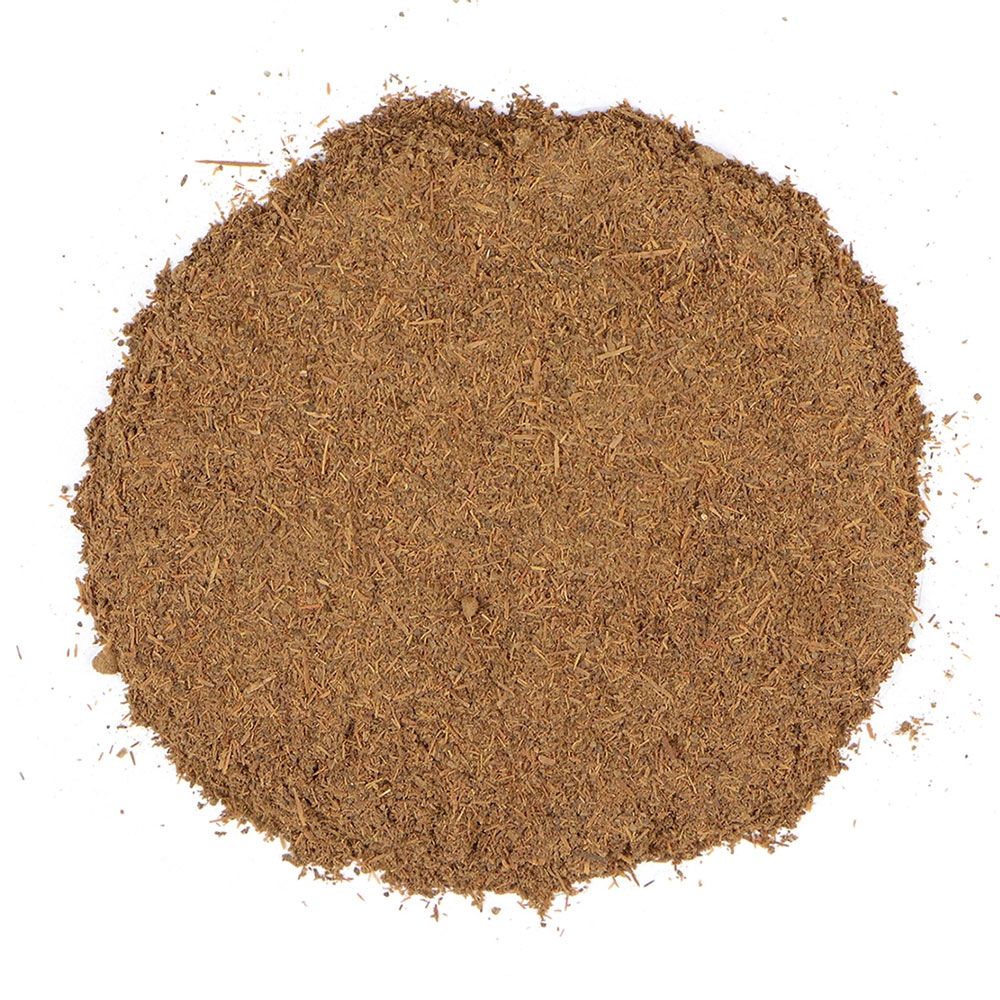
1–2 g — half to one level teaspoon — once or twice daily. Daily total 1–4 g.
Two teaspoons of bark in four cups of simmering water. Simmer for 20 minutes, remove from heat and leave to stand for at least one hour. Strain and drink in small portions through the day. The same decoction, cooled, is used externally as a skin wash.
Quantities are indicative, based on traditional use and published herbal literature. For prolonged use or if you are on medication, consult a health professional.
The bark is generally considered safe at the quantities above. High doses cause nausea, diarrhoea and dizziness, so always start with a small amount. It delays blood clotting: contraindicated in bleeding disorders and with anticoagulant or antiplatelet medication, and discontinued at least two weeks before scheduled surgery. Avoided during pregnancy and breastfeeding. Not intended for vaginal douching. It does not replace antimicrobial or other medical treatment.
Two teaspoons in four cups of water, simmered for 20 minutes and left to stand for at least an hour before straining. Sip in small portions through the day. The long simmer matters because the bark naphthoquinones dissolve poorly in water.
The powder is taken whole, so it also delivers the insoluble fibre of the bark. The decoction delivers only what extracts into water, is gentler on the stomach and can also be used externally.
Of the nearly hundred species in the genus, only a few yield bark rich in naphthoquinones. Correct identification requires experienced harvesters and determines the quality of the bark.
Have you tried Pau d'arco bark powder 100 g? Tell us what you think.
From the same category